We build our own software

TGJOF is the company behind KodiiPay — our rent & property payments platform. We create our own technology to solve real problems, and we share how we build it. If you're building something too, we're glad to help.

1

Flagship product

100%

Made in Kenya

24/7

Systems running

TGJOF ENTERPRISE

Our products need this engineering

Technology for what you're building

From the first idea to the systems running behind it. We don't just build screens — we design, engineer and operate the technology behind digital products. One idea can become an entire digital ecosystem: an app in people's hands, a website for the world, backend systems that never sleep, payments that move real money, AI that handles the routine, and reporting that tells you what is actually happening.

We built KodiiPay to prove the standard. When a project genuinely needs us, this is everything we bring.

01

Product Engineering

We don't just build screens. We design, engineer and operate the technology behind digital products — from the first drawing to the systems running behind it.

Product engineering is the whole journey, not a handoff. We start where the business starts: what the product is for, who it serves, and how it will earn its keep. Then we carry that through design, architecture, build, launch and operation, so the thing that ships is coherent end to end — the marketing page matches the app, the app matches the backend, and the backend actually runs. We found companies, join ventures and build for founders who need a technical partner that thinks about money, users and reality, not just code.

  • Product vision, definition & business model thinking from day one
  • End-to-end ownership — from the first sketch to a running, operated system
  • New-venture founding, partnerships & joint ventures on technical terms
  • Feature roadmaps & priorities that match what users actually do
  • Market fit discovery through real usage, not opinion polls
  • Feedback loops, telemetry & honest iteration on what shipped
  • Documentation & knowledge transfer so the product outlives any one team
Read more
02

Mobile App Development

iOS and Android apps, built for the realities of Kenyan screens, networks and SIM cards — not just for a design mockup.

A mobile app is how most businesses now reach their users, and the phone is where money moves in Kenya. We build apps that install cleanly, start fast, tolerate weak or flapping networks, keep working offline and sync when a connection returns, and move real M-Pesa money inside the flow. We test on the actual devices, operators and price tiers your customers use — not only on the newest flagship in a lab — and we handle the store work that gets it live and keeps it live in both the Play Store and the App Store.

  • Native & cross-platform with Flutter and React Native
  • Offline-first with background sync for flaky-network realities
  • M-Pesa money movement inside the app (STK Push, callbacks, confirmations)
  • Push notifications, deep linking & in-app messaging
  • App Store & Play Store publishing, screenshots, compliance & updates
  • Testing on real, affordable devices across Kenyan operators
  • App lifecycle management, versioning & store optimization
Read more
03

Web Application Development

Dashboards, portals and tools that feel like software — not like a bunch of linked pages.

Web apps are where work actually gets done in most companies — the dashboard a manager opens every morning, the portal a client signs into, the tool a support team runs on. We build them to feel like software rather than documents: realtime updates when somebody else changes the data, roles and permissions that decide exactly what each person can see and do, and an interface that stays calm even when the data behind it is huge. Multi-tenant workspaces mean one product can serve hundreds of organisations without hundreds of copies.

  • React, Vue & modern frontend stacks with real state management
  • Realtime updates with WebSockets & live data subscriptions
  • Authentication, roles, permissions & multi-tenant workspaces
  • Admin dashboards, client portals & internal operator tools
  • Offline-tolerant editing that syncs when the connection returns
  • Progressive Web Apps that install and behave like native apps
Read more
04

Website Development

Fast, SEO-ready websites that rank on Google and turn visitors into customers.

For most buyers, your website is your company — the place they check before they trust, call or buy. We build sites that load near-instantly, are pre-rendered so search engines index them properly, and are engineered around conversion: clear paths from visitor to inquiry, to purchase, to sign-up. Technical SEO, schema, sitemaps and rich results are part of the build, not an add-on done later. Self-service CMS options let your team change copy and images without calling a developer, and analytics tell you which pages actually earn.

  • Pre-rendered for speed and search-engine friendliness
  • Technical SEO baked in from day one — titles, schema, sitemaps, rich results
  • Core Web Vitals treated as a requirement, not an afterthought
  • CMS & self-service editing for your own team
  • Analytics, funnels & conversion paths that show what earns
  • Landing pages, brochures & marketing sites that match the product
Read more
05

Desktop Applications

Windows tools and admin dashboards for teams who work at a workstation all day.

Not everything belongs in a phone. Operations teams, cashiers, accountants and managers live at workstations, and their tools should feel native to that: fast, keyboard-friendly, patient with large datasets, and strong at printing and exporting reports. We build desktop applications for Windows that work offline during outages and sync when the network returns, including internal tools, operations portals, point-of-sale systems and office management software — complete with installers and automatic updates so the whole fleet stays current.

  • Fast, native-feeling desktop UX with full keyboard support
  • Works offline during outages, syncs when connected
  • Internal tools, operations portals & admin workbenches
  • Installers, automatic updates & fleet rollout
  • Print, PDF & export reporting made for real offices
  • Point-of-sale & office management systems
Read more
06

SaaS Platforms

One product, many customers — multi-tenant software ready to scale from the first signup.

Software as a service is the difference between building a product once and selling it a thousand times. We architect platforms as properly multi-tenant from the first signup: every customer's data isolated by design, plans and subscription billing handled cleanly, workspaces and teams with role-based access, and feature flags so you can roll out carefully instead of abandoning the new thing that surprised you. White-label options let partners put their own brand in front of their customers while you keep running the machine.

  • Multi-tenant architecture with real data isolation from day one
  • Subscription billing, plans, trials & upgrade paths
  • Workspaces, teams & role-based access for every account
  • Feature flags & staged rollouts that de-risk releases
  • White-label & partner branding options
  • Usage analytics & retention tooling that show who stays and why
Read more
07

Backend Engineering

The systems behind the screen: logic, data, security and jobs that run whether anyone is looking or not.

The part users never see is the part that decides whether a product survives. Backend engineering is where business rules live, where data is protected, where integrations are held together, and where the scheduled jobs run at 2am without a human. We build backends that keep correct records under concurrency, that refuse to double-charge because of idempotency, that log what happened so problems are foundable, and that stay fast and sane as the dataset grows. This is the layer where most money-grade products prove themselves.

  • REST, GraphQL & well-typed APIs with consistent contracts
  • Business logic placed deliberately — not scattered across layers
  • PostgreSQL, MySQL & MongoDB with migrations & indexes done properly
  • Caching, queues & scheduled jobs that run reliably
  • Authentication, authorization & audit logging for every sensitive action
  • Idempotency engineered for anything that moves money or state
Read more
08

API Development

APIs for your own apps, your partners, or the public — versioned, documented and protected.

An API is a product with its own users, and we build them like one: versioned so existing consumers never break, documented so strangers can integrate without a phone call, and protected so abuse doesn't drain your resources. We handle the machinery most people get wrong — scoped keys, OAuth flows, rate limits that are actually enforced, webhooks signed and retried so your partners can trust them, and usage metering so you know who is consuming what.

  • Versioned REST & GraphQL with backward-compatibility discipline
  • API keys, OAuth2 & scoped tokens for every consumer class
  • Rate limiting enforced at the gateway, not just politely requested
  • Webhooks with payload signing, retries & dead-letter handling
  • Developer documentation & reference clients that work first try
  • Usage metering, quotas & per-customer limits
Read more
09

Payment & Transaction Systems

Real money, real movement, real reconciliation. The same discipline that keeps KodiiPay's books honest.

Money software is different from software. A bug in a content site costs a comment; a bug in payments costs cash and trust. We build payment systems with the discipline our own product demands: real M-Pesa integration through Daraja (STK Push, C2B, B2C, B2B), callbacks verified against the gateway so nothing is credited on faith, idempotency so retries never double-pay, ledgers that record every movement, and reconciliation that reconciles — against the gateway's statement, not just against our own records. If you move money in Kenya, this is where we earn our keep.

  • M-Pesa via Daraja — STK Push, C2B, B2C & B2B flows
  • Card gateways & bank transfer rails where they fit
  • Wallets, ledger entries & double-entry money flow
  • Callbacks, retries & terminal transaction states verified
  • Idempotency & double-payment prevention at every layer
  • Reconciliation, fees & rounding handled exactly, never approximately
  • Fraud checks, limits & freeze logic that protect both sides
  • Settlement & payout automation with audit trails
Read more
10

Business Software

Software for how your business actually runs — not how a template pretends it runs.

Generic software forces your business into its shape. We build business software the other way around: shaped around your actual process — your forms, your approval chains, your terminology, your statuses — while staying flexible enough to change when the business does. Whether it is one workflow you want out of Excel or a complete operation replacing three disjoint tools, the result is software your staff actually want to use, with records that are searchable, statuses that are honest, and reports that match the decisions you really make.

  • Built around the specific process, not a generic template
  • From a single flow to a complete operation, grown deliberately
  • Forms, approvals & workflows with an audit trail
  • Records, statuses & searchable history for every item
  • Role-based access for staff, managers & owners
  • Reports that answer the questions you actually ask
Read more
11

CRM & Customer Platforms

Know your customers, serve them properly, and never lose the thread of a conversation.

The customer relationship is a history — every call, every order, every complaint, every follow-up. We build CRMs that keep that history faithfully on one record: contacts and companies with an activity timeline, pipelines that show exactly where every deal sits, follow-up scheduling so nothing slips because someone was busy, and service tickets with resolution tracking instead of 'we'll come back to you.' Email, SMS and WhatsApp messages live on the customer's file, and reporting shows what your pipeline, your staff and your outcomes actually look like.

  • Contacts, companies & a complete activity timeline
  • Pipelines & follow-up scheduling that keep deals moving
  • Email, SMS & WhatsApp recorded on the customer's file
  • Self-service customer portals that deflect simple questions
  • Service tickets & resolution tracking with SLAs
  • Reporting on pipeline, staff performance & real outcomes
Read more
12

ERP & Operations Systems

Systems that run the whole company on one set of books, one inventory, one view of the truth.

When inventory lives in a spreadsheet, purchases in an inbox and finance in a folder, nobody actually knows the state of the company. We build ERP and operations systems that put the whole business on one connected view: inventory, purchasing, orders and suppliers flowing into finance with ledgers that match the bank, across multiple branches and warehouses. Integrations keep it talking to the rest of your stack, and management reporting shows owners what the business is doing — not what each department says it is doing.

  • Inventory, purchasing & orders on one connected record
  • Finance modules & ledgers that reconcile with the bank
  • Suppliers, payables & procurement workflows
  • Multi-branch & multi-warehouse support
  • Integrations into the rest of your stack
  • Management reporting & forecasts for owners
Read more
13

E-commerce

Stores that actually sell, process payments cleanly and deliver without drama.

An online store is a sales operation, not a brochure, so we build them to close: a catalog that is fast and searchable, a checkout that accepts M-Pesa and cards without making customers fight the page, order tracking that keeps buyers calm, and inventory that syncs with the real world so you never sell what you don't have. Campaign hooks — vouchers, discounts, bundles — are built in, and analytics show what sells, at what margin, through which channel, so the store improves instead of plateauing.

  • Product catalog, search & filtering that are genuinely fast
  • Cart & checkout with M-Pesa and card payments done cleanly
  • Order fulfillment, statuses & customer tracking
  • Inventory synced with the shop so stock stays honest
  • Marketing hooks — vouchers, bundles & campaigns
  • Analytics on what sells, at what margin, through which channel
Read more
14

Booking & Reservation Systems

Calendars, availability and payments — with double-booking made impossible by design.

A booking system lives or dies on one promise: no two customers get the same slot. We build availability systems where the conflict is impossible by design — row-locked calendars, atomic booking logic and waitlists — not just by discipline. Clients and staff get dashboards that show reality in real time, deposits and holds move money correctly, refunds follow the right rules, and reminders chase no-shows before the empty chair costs you again. Rescheduling shifts records, not just the calendar.

  • Real-time availability calendars with live state
  • Conflict-free booking logic enforced at the database level
  • Client & staff dashboards that show the same truth
  • Deposits, holds & refunds accounted correctly
  • Reminders & no-show follow-up flows
  • Rescheduling that keeps the accounting correct
Read more
15

Communication Systems

Reach people where they actually are — email, SMS, WhatsApp and push, reliably delivered.

Reaching customers reliably is harder than it looks: emails land in spam, SMS gets lost, push notifications get denied. We build communication systems engineered for deliverability — transactional email with proper DKIM/SPF and templates, SMS and WhatsApp with correct sender IDs, push notifications and an in-app inbox as the reliable fallback. Delivery is tracked, failures get fallbacks instead of silence, history stays on the record where it belongs, and consent and message limits keep you on the right side of spam rules and customers.

  • Transactional email with professional templates & deliverability settings
  • SMS & WhatsApp messaging with correct sender identity
  • Push notifications & a dependable in-app inbox
  • Delivery tracking & automatic fallbacks
  • Conversation history on the permanent record
  • Consent management & message-limit controls
Read more
16

Automation

Work that used to need an employee every single day, running itself overnight.

Most operations are full of work that repeats identically every day — reminders to send, reports to compile, statuses to update, documents to generate. We turn that work into rules and scheduled jobs that run themselves: triggers that fire on events, approval chains that enforce who signs what, escalations when nobody acted, documents generated and distributed, and an audit trail of exactly what the system did. Your people move up to the exceptions — the ones judgement is actually for — instead of repeating the same four steps.

  • Rules, triggers & scheduled jobs that run without supervision
  • Approval chains & escalations that enforce process
  • Automatic reminders & follow-ups on schedule
  • Document generation & distribution on autopilot
  • Integrations that carry data between your tools
  • An audit trail of every automated action
Read more
17

Digital Staff

Software that collects, reminds, reports and reconciles — like a dependable employee who never sleeps.

Some jobs don't need a person as much as they need persistence. A digital staff member is software that does a real operational job end to end: it collects what is owed, it reminds without forgetting, it produces the reports that used to cost an afternoon, and it reconciles records so the numbers are verified, not assumed. It works across whatever channels your customers are actually on, follows up until the thread closes, and scales without you hiring ten more people to do the same chase. This is the software that answers 'who's on top of this?' with 'it's already handled.'

  • Automated collection & follow-up workflows that don't forget
  • Reminders that actually chase until the matter closes
  • Reports that arrive where and when they're needed
  • Reconciliation that is verified against source records
  • Acts across channels & tools your customers use
  • Scales with your operation without adding headcount
Read more
18

Artificial Intelligence

AI where it genuinely helps — not AI for the sake of the word.

We treat AI as a tool in the build, judged by the same yardstick as everything else: does it make the operation cheaper, faster or more correct? LLM-powered assistants and copilots that answer from your own data, document understanding and summarization that turns paper piles into records, classification and routing that triage requests before a human looks, recommendation that moves the numbers — all with human-in-the-loop where the cost of a wrong answer is high. Everything is costed (AI bills are real), measured and safe to run in production.

  • LLM-powered assistants & copilots grounded in your own data
  • Document understanding & summarization for paper-heavy operations
  • Classification, routing & triage before a human picks it up
  • Recommendation & personalization that move real numbers
  • Human-in-the-loop where a wrong answer costs money
  • Costed, measured and safe to run in production
Read more
19

Data & Analytics

Know what is actually happening, not what you hope is happening.

Decisions made on spreadsheets are decisions made on whatever got exported last week. We build data systems that give you a live, trustworthy picture: pipelines that move data from your systems into a warehouse, dashboards that answer the questions you ask weekly, scheduled reports that land without being chased, forecasting that uses what actually happened, and anomaly detection that flags the day that quietly went wrong. Data quality and lineage mean you can trust what you're looking at — and dashboards are built for owners, managers and staff, not just for the one analyst.

  • Data pipelines & warehouses fed live from your systems
  • Dashboards & scheduled reports that answer real questions
  • Financial & operational reporting on one set of numbers
  • Forecasting & anomaly detection on actual history
  • Data quality, dedup & lineage you can rely on
  • Dashboards for owners, managers & staff alike
Read more
20

Search Systems

Find anything in seconds, even when you don't remember what you're looking for.

A product with data is only as good as its ability to find it again. We build search that finds things fast even when the user is fuzzy about the term — full-text and fuzzy matching, facets and filters that narrow a thousand results to the right five, autocomplete that saves keystrokes, and ranking tuned to your content rather than a default configuration. It spans documents and records, tolerates typos with a straight face, and stays quick as the collection grows from thousands to millions.

  • Full-text & fuzzy search with correct relevance
  • Facets, filters & autocomplete that speed up real searches
  • Ranking tuned to your content & your users
  • Search across documents, records & attachments
  • Typo-tolerant matching without degrading results
  • Fast results even at very large collection sizes
Read more
21

Cloud Engineering

Infrastructure that scales without a midnight page, on the provider that fits your budget.

The right cloud setup is invisible: it scales when traffic spikes, it stays up while you sleep, and it bills you sanely. We engineer on AWS, GCP, Azure and Supabase — choosing the provider for the workload and the budget rather than brand loyalty — with serverless and container platforms that auto-scale, backups and regions that cover you, and disaster recovery with SLAs you can actually hold. Cost control and reserved capacity keep the bill predictable, and security groups and network isolation mean infrastructure doesn't become the vulnerability.

  • AWS, GCP, Azure & Supabase chosen by fit and budget
  • Serverless & container platforms that scale automatically
  • Autoscaling, backups & region redundancy by design
  • Cost control & reserved capacity for predictable bills
  • Disaster recovery & SLAs you can actually hold
  • Security groups & network isolation on every workload
Read more
22

DevOps & CI/CD

Ship constantly, safely — with a pipeline that catches mistakes before users do.

Software that ships twice a year ships fear. We build continuous delivery pipelines where every commit is built, tested and deployable, automated tests gate every release so mistakes are caught before users see them, and staging mirrors production so surprises happen somewhere harmless. Deployments are zero-downtime, rollbacks are fast and rehearsed, and every change is tracked and auditable. The result is a team that ships weekly — sometimes daily — because the pipeline made it the safe option rather than the brave one.

  • Build, test & deploy pipelines that run on every commit
  • Automated tests gating every release
  • Staging & production environments that mirror each other
  • Fast, rehearsed rollbacks & release discipline
  • Zero-downtime deployments without late-night drama
  • Change tracking & auditability for compliance
Read more
23

Infrastructure as Code

The whole platform described in code — reproducible, reviewable and safe to change.

When infrastructure is click-configured, nobody really knows what the platform looks like and change is a nervous ceremony. We describe the entire platform as code — Terraform and IaC platforms — so environments are reproducible from nothing, dev matches prod, infrastructure lives in version control reviewed like any code, and security is default-enforced in every template instead of remembered. Rollbacks return you to a known state. And the complete history of the platform is auditable, which matters more than most teams admit until they need it.

  • Terraform & IaC platforms as the source of truth
  • Reproducible environments from dev to prod with parity
  • Version-controlled infrastructure reviewed like code
  • Security by default in every single template
  • Change reviews before anything moves in the platform
  • A complete, auditable history of the platform
Read more
24

Cybersecurity

Security treated as engineering, not as a checkbox — the standard KodiiPay is held to.

Security in most products is a list of things someone meant to do. We treat it as engineering: authentication and authorization designed rather than bolted on, encryption at rest and in transit everywhere it matters, secrets managed so keys aren't in the codebase or the config file, and least privilege applied to every database policy, edge function and admin tool. Rate limiting and abuse protection stop the noisy attackers, pen-test discipline and review catch the quiet ones, and monitoring, detection and response mean incidents are found in minutes, not months. For a payments business, this is the difference between surviving and not.

  • Authentication & authorization designed, not bolted on
  • Encryption at rest and in transit, everywhere it matters
  • Secrets, keys & credentials managed properly
  • Least privilege on every policy, function & admin tool
  • Rate limiting & abuse protection that stop the noise
  • Pen-testing discipline & security review
  • Monitoring, detection & response when something slips
  • Security documentation delivered as part of the build
Read more
25

UI/UX Design

Interfaces people actually understand the first time — without being taught.

The best interface is one nobody has to explain. We research before we draw, so screens are built around how the user actually thinks rather than how the org chart does, and we test on real users before we commit. Wireframes and flows settle the architecture of the experience, prototypes let users feel it before a single line of product code, and visual design brings a deliberate system rather than free-styled taste. Motion and micro-interactions are used with purpose — to guide, confirm and reassure — and the whole thing is designed to survive contact with real people, real devices and real networks.

  • User research before pixels — how users think, not how you assume
  • Wireframes, flows & prototypes that settle experience early
  • Visual design with a clear, deliberate system
  • Usability testing on real users before commitment
  • Motion & micro-interactions with purpose, not decoration
  • Design that survives real devices, networks & people
Read more
26

Product Design Systems

One standard, every build — components, tokens and rules that keep every screen consistent.

Inconsistent software looks cheap no matter how much you spend. A design system makes consistency the default rather than the achievement: design tokens for color, space and type, a component library that engineers actually consume, living documentation so the rules are discoverable, light and dark theming without the usual chaos, and accessibility built into the components so it doesn't have to be retrofitted per screen. The system is versioned and evolves with the product — adopted by developers because it saves them time, not because a document told them to.

  • Design tokens & component libraries engineers actually use
  • Living documentation that stays current
  • Light & dark theming handled once, correctly
  • Accessibility built into the components themselves
  • Adopted by the dev team because it's faster, not mandated
  • Versioned & evolving with the product
Read more
27

Quality Assurance

Tests that protect money and trust — because with payments, a small regression costs cash.

Quality assurance on a money product isn't a nice-to-have; a regression in the payment path costs customers cash and trust in real time. We build automated unit, integration and end-to-end tests that run on every release, manual QA for the human touches automation can't judge, and edge-case and boundary testing that finds the bug your users would have found first. Payment and reconciliation scenarios are tested as scenarios — double-submission, retries, partial failures, exact rounding — and regression suites exist precisely to ensure what we already fixed never comes back. Bugs are triaged with clear severity so the scary ones never wait behind the cosmetic ones.

  • Automated unit, integration & E2E test suites
  • Manual QA for the feel automation can't judge
  • Edge-case & boundary testing that finds hidden bugs
  • Payment & reconciliation scenarios tested as scenarios
  • Regression suites protecting everything already fixed
  • Bug triage with clear severity & honest priorities
Read more
28

Performance Engineering

Fast everywhere — no matter the device, network or number of concurrent users.

Speed is a feature, and on Kenyan networks it's a loyalty feature — a slow app gets deleted. We engineer performance deliberately instead of discovering it at launch: load and stress testing that shows where it breaks before traffic does, query and index optimization so the database doesn't become the wall, caching at the right layers instead of everywhere cheaply, and performance budgets that hold the line as features multiply. We measure Core Web Vitals and app start times, and we test on slow networks, not just the office Wi-Fi — because the customer who matters is the one on the flaky connection.

  • Load & stress testing before launch, not after
  • Query & index optimization at the database layer
  • Caching placed at the right layers, not everywhere
  • Core Web Vitals & app start-time budgets
  • Performance budgets enforced as features are added
  • Tested on slow networks, not just office Wi-Fi
Read more
29

Accessibility

Software that works for everyone, including people who use keyboards, screen readers or both.

Accessible software isn't charity; it's a larger market and a legal posture in one. We align with WCAG as an engineering discipline rather than a checklist titled to pass an audit: full keyboard navigation for people who never touch a mouse, screen-reader testing with the actual tools users run, contrast and text-size compliance that doesn't fight the design, and inclusive patterns built in by default instead of patched on complaints. Accessibility is tested alongside the features it ships with, so it stays part of the product rather than a periodic cleanup.

  • WCAG-aligned as discipline, not titled for an audit
  • Full keyboard navigation for mouse-free users
  • Screen-reader testing with real assistive tools
  • Contrast & text-size compliance without ugly compromises
  • Inclusive by design, not patched after complaint
  • Accessibility tested alongside every feature
Read more
30

Integrations

Make everything talk — your systems, third parties, old tools and new platforms.

Software never lives alone. We build integrations that make your systems talk: third-party APIs connected with correct contracts, webhooks and event-driven sync so changes propagate immediately instead of in end-of-day batches, and legacy connectors that let the old tool keep running while modern logic happens elsewhere. Data mapping and transformation are explicit — fields land where the receiving system actually expects them — and retries, failure handling and reconciliation are built in so a flaky partner doesn't silently corrupt your records. Every integration is monitored like the production path it is.

  • Third-party API integrations done to contract
  • Webhooks & event-driven sync instead of nightly batches
  • Legacy system connectors that keep old tools working
  • Explicit data mapping & transformation
  • Retry, failure & reconciliation handling for flaky partners
  • Integration monitoring treated as production
Read more
31

Legacy System Modernization

Upgrade without stopping the business — old data kept, new capabilities gained.

Replacing a system that runs the business is a risk most companies can't take in one jump, and we don't ask them to. We start with an honest audit of what exists and what it actually costs to keep, then migrate in phases that keep the business running the whole time: wrapping the legacy behaviour behind modern APIs so new features build on clean ground, carrying the data across preserved, validated and understood, and retraining staff with documentation they can actually use. We deliver in steps with the business live throughout — not a big-bang rewrite that bets the company on a perfect launch.

  • Honest audit of what exists & what it costs to keep
  • Phased migration that keeps the business running
  • Legacy behavior wrapped behind modern APIs
  • Data preserved, validated & carried across correctly
  • Staff retraining & documentation that match reality
  • Delivered in steps, never a big-bang bet
Read more
32

Data Migration

Move data safely, so the story behind it survives the move.

Data migration is where businesses quietly lose their history — a column mapped wrong, records silently dropped, references broken so the new system doesn't know who owes whom. We move data as the operation it is: extraction from any source including the ones nobody documented, transformation that preserves meaning rather than just shapes, validation and reconciliation before cutover so the old and new systems agree, and a planned cutover with a rollback that actually works. Post-move verification and sign-off confirm the story survived — including documents, files and records, not just the database.

  • Extraction from any source, documented or not
  • Transformation that preserves meaning, not just shape
  • Validation & reconciliation before cutover
  • Planned cutover with a rollback that works
  • Post-move verification & explicit sign-off
  • Documents, files & records migrated too, not just tables
Read more
33

Maintenance & Support

We stay with the product after launch — because software is a system, not a handover.

Launch day is the start of the software's life, not the end, and we stay with what we build. Our support runs to SLAs with clear response times, dimensioned for how critical the system is — a payments path gets different attention than a brochure site. Monitoring backs the support so issues are often found before you report them, bugs are fixed in priority order rather than whoever shouts loudest, and dependencies and security updates are applied because stale frameworks are how systems die quietly. Documentation stays current, and reviews suggest honest improvements instead of protecting the status quo.

  • SLAs with response times matched to system criticality
  • Monitoring-backed support that finds issues first
  • Bug fixes in priority order, not loudness order
  • Dependency & security updates applied, not scheduled forever
  • Documentation kept current as the product changes
  • Reviews that recommend honest improvements
Read more
34

Monitoring & Observability

See everything — the moment something drifts, not a week later in a report.

Most problems are visible before they become incidents — if you're looking. We build observability so you see everything in the moment: uptime and health dashboards that show reality at a glance, logs, traces and metrics centralized so a bug can be followed from symptom to root cause, and alerting that reaches the right person instead of a mailbox nobody checks. Scheduled checks catch drift that only shows up weekly, cost and usage observability stops the bill from surprising you, and post-incident reviews produce actual learnings rather than a token post-mortem. When something goes wrong, you find out in minutes — and you find out what really happened.

  • Uptime & health dashboards that show reality at a glance
  • Logs, traces & metrics centralized and searchable
  • Alerting that reaches the right person in the right channel
  • Scheduled checks that catch slow drift
  • Cost & usage observability that tames the bill
  • Post-incident reviews with real learnings
Read more
35

Technical Consulting

Honest advice, even when the honest answer is 'you don't need to build it yet.'

We advise clients during and before builds, and the honest answer is part of the service — sometimes the right advice is 'don't build this yet' or 'buy this instead,' and saying so earns more trust than saying yes. We run architecture and security reviews that find the problems quietly waiting, codebase and tech-debt assessments that quantify what the shortcuts are costing, cost and infrastructure reviews that find the bill's escape routes, and build-versus-buy recommendations argued from your situation, not from our roster. Where the risk lives in the unknown, we prototype the risky part before you commit the budget.

  • Architecture & security reviews that find quiet problems
  • Codebase & tech-debt assessments with numbers
  • Cost & infrastructure reviews that find bill leaks
  • Build-versus-buy recommendations from your situation
  • Team guidance & technology strategy that stick
  • Prototypes of the risky parts before the budget commits
Read more
36

Research & Prototyping

Test the risky parts before committing the budget.

The most expensive mistake in software is building the wrong thing well. We test the risky parts before you commit: user research and interviews that find what people actually do rather than what they claim, market and competitor checks that test whether the gap is real, feasibility and cost estimation that replace guesses with planning numbers, and interactive prototypes that feel real enough that users react honestly. Signals from real users are gathered and weighed, and the output is go/no-go evidence rather than enthusiasm — so a bad fit costs you a prototype, not a product.

  • User research & interviews on real behavior
  • Market & competitor checks that test the gap
  • Feasibility & cost estimation with planning numbers
  • Interactive prototypes real enough for honest reactions
  • Signals gathered from real users, weighed honestly
  • Go / no-go evidence, not guesswork and enthusiasm
Read more
37

MVP Development

Launch the smallest version that proves the product — then grow on evidence.

An MVP is not a smaller scope — it is the smallest scope that proves the idea's riskiest assumption. We build it deliberately: scoped to what proves the product rather than what rounds out the feature list, shipped fast so the market answers while the question is current, and measured immediately so you know what worked. The money flow and core loop come first — because if the core loop doesn't work, the polish doesn't matter — and feedback is wired back into the build on a released cadence rather than a hidden long cycle. Iteration releases replace the perfect-v1 myth, and the path to the full system is known in advance so v1 isn't a dead end.

  • Scoped to prove the riskiest assumption, nothing more
  • Shipped fast while the market question is still current
  • Measured immediately so you know what worked
  • Money flow & core loop built first, polish later
  • Iteration releases instead of the perfect-v1 myth
  • The path to the full system known before v1 ships
Read more
38

Scaling

Grow from hundreds of users to millions without breaking the thing that made it work.

Scaling is where products reveal whether the architecture was honest. We plan for the journey rather than hoping: capacity and bottleneck planning that finds the wall before traffic does, concurrency-safe data and payment paths so growth doesn't introduce double-charges or lost writes, and distributed systems done carefully — because distributed is harder, not just bigger. Costs are engineered to scale sanely with traffic instead of linearly with panic, and team and process keep up so the humans don't become the bottleneck. And we scale without sacrificing the money-grade discipline that got you there in the first place.

  • Capacity & bottleneck planning before the wall is hit
  • Concurrency-safe data & payment paths under load
  • Distributed systems adopted deliberately, not by accident
  • Cost engineered to scale sanely with traffic
  • Team & process designed so people don't become the wall
  • Scaling without losing the money-grade discipline
Read more
39

Technology Strategy

Decisions that compound — the stack, the architecture, the roadmap and the risk.

Technology decisions are compounding — every stack choice, architecture corner and 'we'll fix it later' earns interest, for good or ill. We help companies make decisions that pay interest in the right direction: stack choice argued with reasons rather than habits, architecture chosen to survive the growth you expect rather than the demo you're showing, and build-versus-buy judged honestly against your actual situation. Security and compliance are positioned from the start rather than discovered at procurement, roadmaps are sequenced by value rather than by internal enthusiasm, and the whole strategy serves the business — not a technology team's preferences.

  • Stack choice made with reasons, not habits
  • Architecture chosen to survive real growth
  • Build-versus-buy judged from your actual situation
  • Security & compliance positioned up front
  • Roadmaps sequenced by value, not enthusiasm
  • Technology that serves the business, not the reverse
Read more

From one screen to the entire system

A single feature can become a boardroom system — and it doesn't have to be a nightmare. Every project moves through the same chain, and we hold every step to the same standard:

IdeaResearchStrategyUXUIArchitectureFrontendMobile, Web & DesktopBackendAPIsDatabaseAuthAuthorizationSecurityPaymentsAutomation & AICloudTestingCI/CDDeploymentMonitoringMaintenanceScaling

We don't just build software. We build the systems behind ideas.

Our flagship product

KodiiPay — proof of how we build

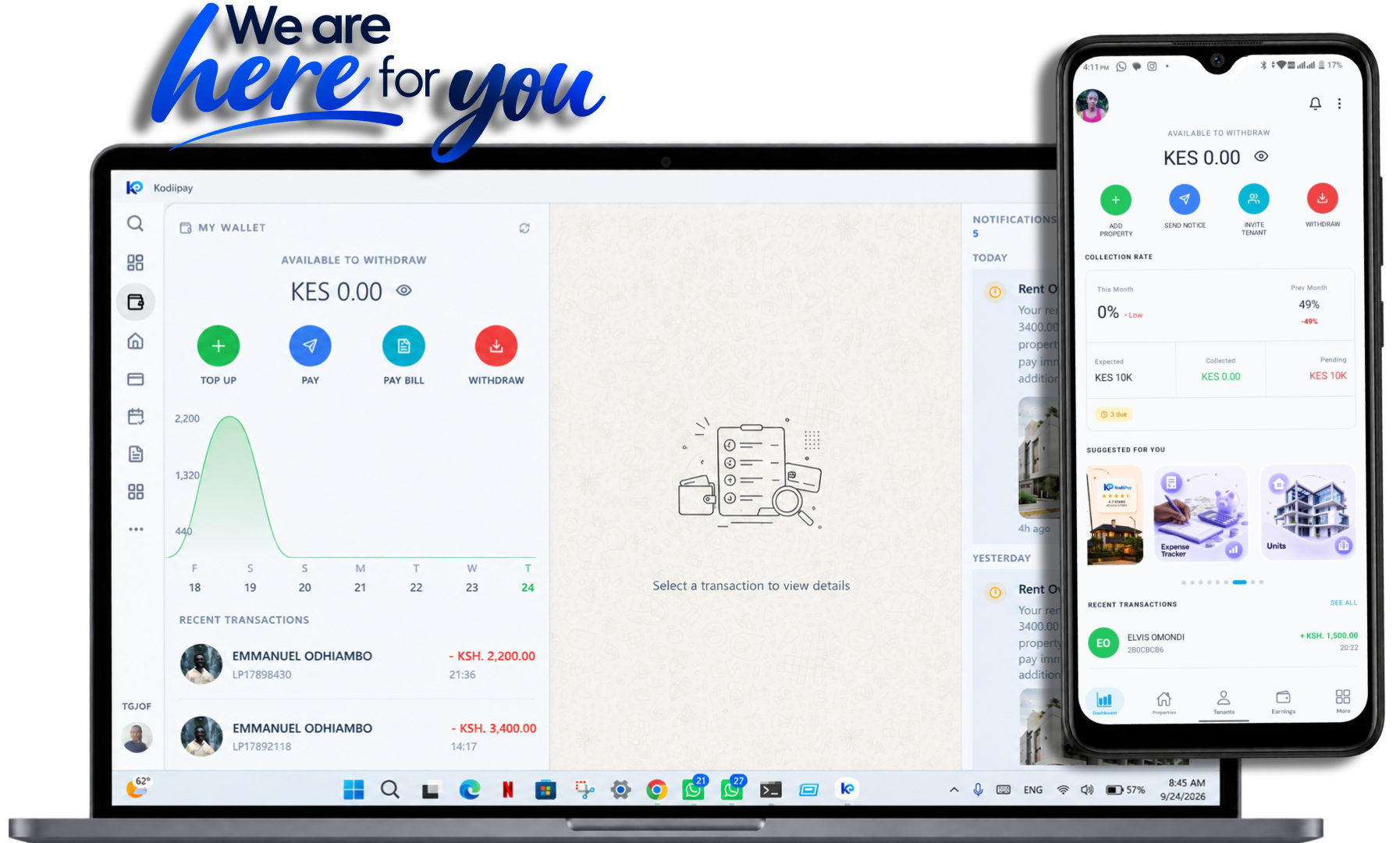
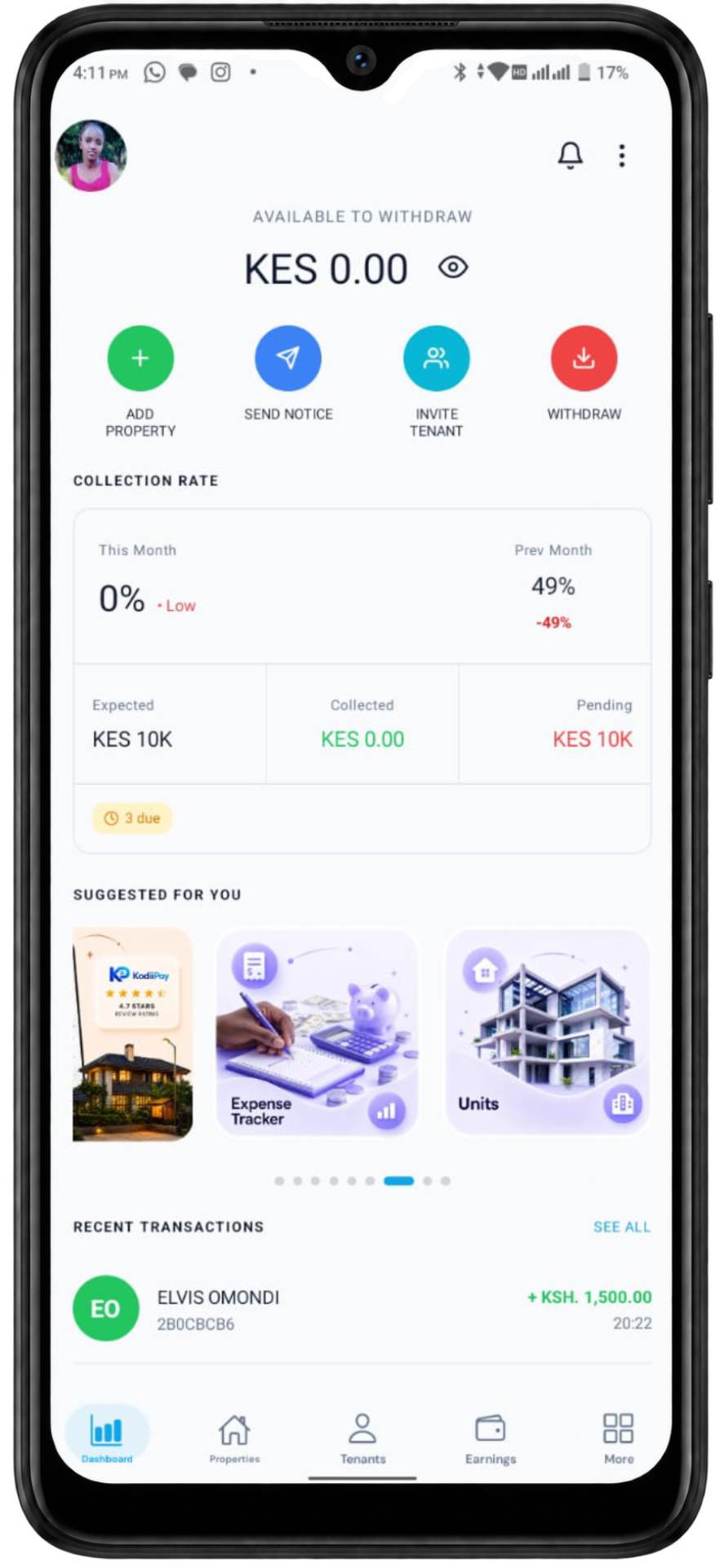
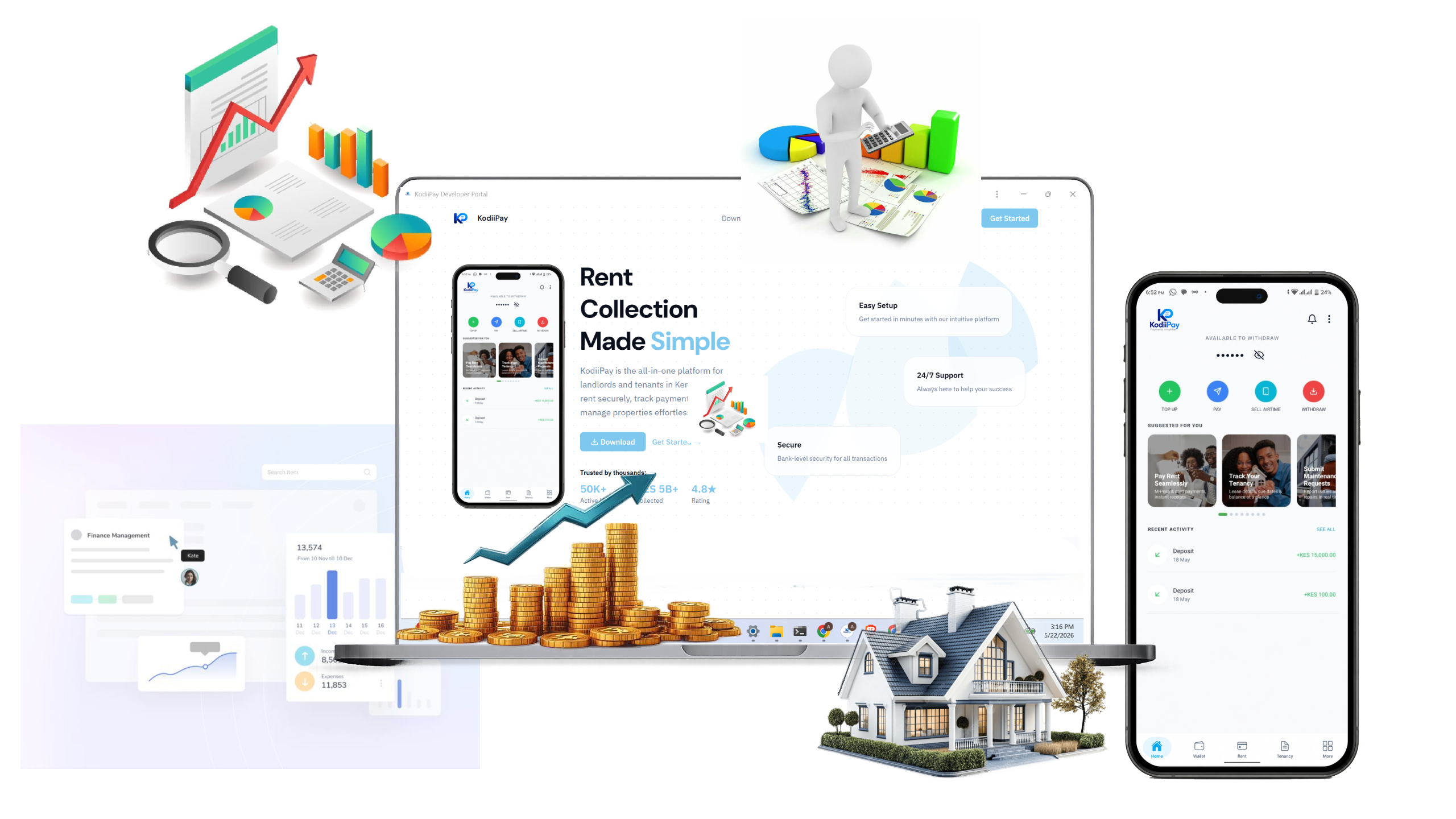
KodiiPay is our rent & property payments platform for Kenya. Tenants pay rent with M-Pesa, landlords withdraw or route money straight to their PayBill, and property owners get live books. Building it taught us exactly how hard money-moving software is — and every client project benefits from that lesson.

  • Real M-Pesa integration, callbacks and reconciliation
  • Mobile apps for tenants & landlords, desktop for owners
  • Built for scale — security and reliability baked in
KodiiPay — rent & property payments app preview

Under the hood

This is the real engine behind the product.

TGJOF builds the systems behind real businesses: payments, workflows, customer experiences, integrations and operational tooling — all designed to survive live usage, not just a polished demo.

Built for business reality

We build the systems behind the product — so the business can keep running when the pressure is real.

That means product engineering, payments, reconciliation, digital staff, automation, CRM and ERP logic, multi-rail integration and operational tooling — the machinery behind the business, not just the interface customers see.

Payments

M-Pesa, Daraja, Stripe, Paystack, cards, bank rails and wallet flows are all held to the same verification and reconciliation discipline.

Integration

CRM, ERP, accounting tools, APIs, SMS, WhatsApp, email, file systems and partner services connect under one governed layer.

01

Product engineering from idea to operations

We design, build and operate digital products end to end — from the first sketch to the live system behind it. That means business logic, user flows, architecture, security, deployment and long-term ownership all live in the same thinking, not in disconnected teams.

02

Real payment systems, not just payment screens

We build financial flows that handle actual balances: STK Push, PayBill, Till, B2B, B2C, wallets, card rails, bank transfers and any gateway a business already uses. Every callback is validated, every retry is idempotent and every ledger movement is reconciled against the rail that actually moved the money.

03

Digital staff and workflow automation

Some jobs need persistence, repetition and reliable follow-through more than a person. We build software that behaves like dependable operational staff: reminders, follow-ups, approvals, reconciliations, escalation logic and scheduled jobs that keep the business moving without manual chasing.

04

API and system integration across the whole stack

We integrate the systems businesses actually depend on: M-Pesa and Daraja, banks, CRMs, ERP systems, accounting tools, WhatsApp, SMS, email, push notifications, partner APIs and internal services — all under one governed architecture with retries, observability and security.

05

Business systems that match real operations

From mobile apps and web portals to ERP workflows, ecommerce checkout, customer platforms and internal tools, we build software that reflects the way a business actually runs — not a template pretending to know better.

Why TGJOF

Built to be trusted with your money

We hold our engineering to the standard of systems that handle cash — because many of ours do.

Money-grade

We hold our engineering to the standard of systems that handle cash — because many of ours do.

You own it

Your code, your data, your product. No lock-in to TGJOF.

Made in Kenya

Engineered in Nairobi with world-class, money-grade discipline.

The principles we engineer to

Six rules come with every build

Not a checklist — a way of working. These are the same rules KodiiPay runs on.

Security before features

Every payment function is rate-limited, idempotent and double-checked against balance constraints — because money is involved.

Reconciliation as religion

Callbacks, ledgers and terminal transaction states are verified end-to-end. Nothing is credited until the gateway confirms it.

Least privilege everywhere

Database policies, edge functions and admin tools all run under the narrowest permissions needed. Escalation is the exception, not the rule.

Built for scale

Advisory-locked batch jobs, FOR UPDATE row locks, index-backed queries and capped batch sizes keep things fast even with millions of users.

Audit as a feature

Every write is led to an immutable trail — wallet ledgers, payment gateway logs and action logs that the client can read.

Honest scoping

We tell you the right platform, the real budget and what software can't do — before you spend a shilling.

TGJOF ENTERPRISE — the principles we engineer to

One standard, every build

These rules are not optional when money is involved.

They apply to every TGJOF build — the discipline that runs KodiiPay today is the discipline we bring to your product: mobile, desktop, web, automation or digital staff.

How we build

From idea to running software

The same path we take for our own products — visible progress, no smoke and mirrors.

01

Discovery

We learn your business, your users and where money moves — and honestly whether software is the right fix.

02

Plan

The right platform, a phased build and a clear budget you can defend to anyone.

03

Build

Working software in sprints. You review progress, not slides.

04

Launch & Support

We deploy, train your team and stay as your engineering partner.

Security, built into everything

One product. Twelve grounded layers.

Security is not a feature added at the end of development. It is an architectural responsibility that begins before the first line of code — and it is enforced from the login screen down to the vault beneath the database.

Surface — the login screenLayer 06 — APIs & moneyLayer 12 — the vault floor
Layer 010%

Identity & authentication

Who is allowed in

Every system we build starts with one question: who should be able to enter at all? We establish strong boundaries around identity before anything else exists.

Strong password foundations

Passwords are stored using slow, salted, memory-hard hashing — never reversible. Breached-password checks block known-weak credentials at the door, and users are pushed toward passphrases, not guesses.

Multi-factor authentication

A password alone is never the final gate. One-time codes, TOTP authenticator apps, passkeys, biometrics and backup codes combine so a stolen password is not enough to get in.

Email & phone verification

Accounts verify the contact information that owns them before sensitive actions unlock. Verification links and codes are one-shot, time-limited and rate-limited against brute force.

Recovery that cannot be hijacked

Password reset and account recovery use out-of-band verification, rotating tokens and forced re-verification of the device — so recovery paths do not become takeover paths.

Sessions as temporary trust

Sessions are short-lived credentials, not permanent entitlements. Tokens expire, rotate and are re-verified for sensitive actions, keeping a long-lived session from outliving its need.

Kill switches per session

Any session can be terminated individually or everywhere at once from the account. Losing a device or forgetting a laptop never means permanent access.

Layer 029%

Authorization & access control

What each identity may do

Being logged in is not the same as being allowed. Authorization decides what each account, role, organization or service may actually touch — and it is enforced at the server, not hidden in the UI.

Least privilege everywhere

Every role, service and function runs with the narrowest permission that can do its job. Escalation is the exception, not the rule — and it is always temporary and always logged.

Server-side enforcement

Permissions are enforced in the database and on the server, never only by hiding buttons. Knowing a URL, an endpoint or an identifier grants nothing by itself.

Object-level ownership

Every record is checked against the identity and role that owns it. A user cannot read or act on another user's rows simply by changing an ID in the request.

Deny by default

New capabilities, endpoints and roles start locked and are opened deliberately. Nothing is accessible simply because nobody remembered to close it.

Role & service separation

Admin tools, user applications and server-side services each run under their own identity model with their own credentials and their own boundary.

Administrative privilege discipline

Admin accounts are not universal keys. Elevated roles require stronger authentication, guarded sessions, reviewable audit trails and, for the most sensitive operations, approval workflows.

Layer 0318%

Session & device security

Accounts across every screen

Modern software lives on phones, desktops and browsers at once. We design the relationship between accounts, sessions and devices so one weak device can be cut out without taking the account down.

Device registration & limits

Devices are registered, named and bounded. A hard device limit prevents unlimited session growth and makes a large session list itself a detection signal.

Remote logout everywhere

Users can see every active session and terminate any of them — including a device they no longer own — from any other trusted session.

App lock & biometrics

Local app locks (PIN) and biometric protection add a second gate on the device itself, so an unlocked phone does not equal an unlocked account.

Device-link verification

Pairing a new device uses a verified, time-limited link approved from an already-trusted session — WhatsApp-style, with the approving device explicitly confirming.

Re-authentication for danger zones

Changing passwords, removing devices, withdrawing money or touching admin functions requires the credentials or an OTP again — freshness is enforced where risk is highest.

Suspicious-session detection

New locations, unusual hours and impossible geography surface as warnings and additional verification steps before trust is granted.

Layer 0427%

Data protection & privacy

The information itself

Security protects information; privacy decides how respectfully it is collected and used. Data is protected across its entire lifecycle: collection, transmission, processing, storage, access, export, backup and deletion.

Data minimization

We collect what a product genuinely needs and nothing more. The safest data is the data that never needed to be collected in the first place.

Purpose & retention limits

Data is used only for the purpose it was gathered, kept only as long as that purpose requires, then deleted — with automated cleanup running behind the scenes.

Encryption in transit & at rest

Communication is encrypted end-to-end between client, server, database and integrations. Stored data, backups and export artifacts are encrypted independently of authorization.

Encrypted at the application layer

Where sensitivity demands it, data is additionally protected before it ever reaches storage — the database does not even hold plaintext for its most sensitive values.

User rights honoured

Access, correction, export and deletion requests are real operations, not promises — including immediate, irreversible account deletion when a user asks for it.

Disclosure-free failures

Errors tell users what happened and what to do next without revealing credentials, stack traces, server paths or internal plumbing.

Layer 0536%

Application security

The software itself

Web and mobile interfaces are built on the assumption that the client is adversarial. Critical decisions are made on the server; the interface only ever proposes.

Input validation on every gate

Every input — from users, APIs, admins, uploads and third parties — is validated for type, format, size and permitted values before it is ever trusted or stored.

Injection-proof by construction

Queries are parameterized, commands are never assembled from strings, and user content is stored and rendered in ways that make injection, XSS and CSRF structurally impossible.

Secure by default headers

Content-Security-Policy, HSTS, CORS, frame and MIME protections are configured deliberately — never defaulted to permissive.

Uploads handled as untrusted

Files are validated by type and size, stored privately, served via signed expiring URLs and stays impossible to enumerate — a stored file is not a public file.

Mobile trusts nothing local

The app stores minimum data locally with protection, runs business logic on the server, and treats the device as an interface rather than an authority.

No small print in errors

User-facing errors are honest and useful; diagnostic detail is written only to protected internal logs where operators can investigate.

Layer 0645%

API, integrations & webhooks

Every boundary with the outside world

Every API is an exposed surface and every integration is a trust boundary. We treat incoming requests and callbacks as hostile until proven otherwise.

Authenticated, authorized, validated

Requests carry verifiable identity, scope and ownership checks before any sensitive operation runs — guessing endpoints or identifiers earns nothing.

Rate limiting sized to the action

Payments, OTPs, logins, uploads and admin operations each carry their own limits. Automation and brute force hit a wall, while honest users never notice one.

Idempotency on every payment path

Duplicate clicks, retried requests and repeated callbacks cannot double-charge or double-credit. Every money movement is idempotent and concurrency-safe.

Callbacks independently verified

Webhooks carry signatures, nonces and expected-resource matching, and are verified against gateway state — no callback is believed on its say-so.

Replay protection

Timestamps, nonces and event identifiers make a captured request useless twice. Duplicate events are detected and neutralized, not replayed.

Integrations granted the minimum

External services get only the permissions they need, are monitored for failure and can be isolated or revoked without collateral damage.

Layer 0754%

Database security

The vault under everything

The database is a security boundary in its own right, not a storage bucket behind the app. App-level rules are never the only lines standing between a user and sensitive data.

Row-level security

Policies at the database layer restrict every query to rows the caller is allowed to see — a tenant, landlord or owner can only ever reach their own data.

Least-privilege database roles

Application roles, service roles and admin roles each hold separate credentials with precisely scoped rights. No shared superuser for everyday work.

Transaction & constraint discipline

Referential integrity, uniqueness and check constraints protect data at the source, and balance checks run inside row locks so concurrent writes cannot corrupt state.

Protected admin operations

Schema changes, migrations and administrative queries run under controlled, reviewed processes with documented approval — not ad-hoc privileged access.

Ledgers and audit tables

Wallet ledgers, payment gateway logs and action logs are append-only, immutable trails that clients can read and auditors can trust.

Encrypted and recoverable

Sensitive columns and stores are encrypted, backups are encrypted and tested for restoration — a loss to failure or compromise never becomes permanent.

Layer 0863%

Payments, money movement & fraud

Where the money actually moves

For systems that handle cash, security stops being theoretical. Every shilling that moves does so through verified gateways, guarded balances and immutable trails — and fraud is attacked structurally.

Gateway-verified only

Deposits, payouts and transfers are credited solely on confirmation from the payment gateway itself — never on a client claim, never on a callback's say-so.

Multi-layer balance protection

Pre-flight checks, atomic decrements, row locks and non-negative constraints stack so that a balance can never go negative even under race conditions.

Escrow & holds for unsafe states

Money bound for unverified recipients, expired subscriptions or pending KYC is held, refunded or released on the correct condition — never silently lost or paid out.

Callbacks idempotently confirmed

The same STK, B2B, B2C or bank event applied twice produces one result. Confirmation procedures enforce terminal states and locks.

Fraud signals at the gateway

Rate limits, velocity checks, amount sanity and recipient verification flag attack patterns before they can drain a wallet or card.

Refund & dispute paths

Failures refund the exact amount, stale transactions are cleaned and disputed movements have defined, auditable resolution paths.

Layer 0972%

Infrastructure, cloud & network

What keeps it running

The application is one part of the system. Servers, cloud accounts, containers, networking, DNS and certificates are each their own attack surface — and each gets its own boundary.

Private by default

Components that do not need the public internet are not on it. Network isolation, security groups and restricted ports keep exposure minimal and deliberate.

Encrypted everywhere

TLS everywhere, with modern certificates, strict transport security and encrypted inter-service communication — nothing crosses the network in the clear.

Hardened compute

Base images are minimal and patched, containers run non-root, and CIS-style hardening standards are applied to the systems underneath the product.

Identity-based cloud access

Servers and services authenticate to the cloud as identities with narrowly scoped roles rather than long-lived keys lying in config files.

Isolated environments

Development, staging and production are separate worlds with separate credentials, so a breach or a mistake in one cannot walk into another.

Restricted production access

Production is reached through guarded paths — bastions, short-lived credentials and audited approvals — never casually, never by default.

Layer 1081%

Secrets, configuration & supply chain

The keys to the building

Passwords, API keys, signing keys and service secrets are never embedded in code or config files. And because modern software is assembled from packages, the supply chain is part of the perimeter.

Secrets in dedicated vaults

Credentials live in secret managers and environment configuration, separated by environment, rotated on schedule and limited by role and necessity.

No secrets in source code

Empty defaults and injected secrets at deploy time — scanning guards the pipeline so a pasted key never survives a commit.

Dependency auditing

Libraries and frameworks are pinned, audited and monitored for vulnerabilities, and unnecessary packages are removed. A weakness in a dependency is a weakness in the product.

Locked, reviewable builds

Lockfiles, dependency review and software-composition analysis keep the exact tree of packages reproducible and known.

Rotated and revoked

Compromised or stale credentials are rotated immediately, and revoking one key never cascades into breaking unrelated systems.

Supply-chain trust

Package sources are verified and third-party code is treated as untrusted until proven — external never automatically means safe.

Layer 1190%

Operations: logging, monitoring & response

Seeing what is happening

Prevention is not the whole job. Systems must be able to answer what happened, when, by whom, on what, and with what result — and to notice when the answer is unusual.

Event logs with answers

Authentication events, permission changes, sensitive operations, admin actions and failures are recorded so any incident can be reconstructed exactly.

Protected logs

Logs can contain operational secrets, so they are encrypted, access-controlled and guarded as carefully as the systems they describe.

Monitoring for the signal

Repeated failed logins, abnormal API traffic, unexpected admin actions and service anomalies surface immediately instead of silently accumulating.

Alerting wired to people

Detection is useless without a response path. Alerts reach engineers on defined channels with severity triage, not a silent dashboard.

Incident response ready

Containment, eradication, recovery and post-incident review are practiced and documented — not invented in the middle of a crisis.

Failure that is controlled

Dependencies fail, requests time out, deployments go wrong. The architecture defines graceful, observable, recoverable behaviour instead of hoping it never happens.

Layer 12100%

Resilience, testing & governance

Staying standing

Security is a property the system must keep under pressure. Backups are tested, recovery is drilled, and security is continuously probed, reviewed and governed rather than audited once.

Backups that restore

Encrypted backups, retention windows and recovery procedures exist — and restoration is actually tested, because an untested backup is a hope, not a plan.

Business continuity

Outages in third parties, databases or networks are absorbed by defined paths that control, observe and recover from failure.

Continuous security testing

Authentication, authorization, API, injection, session, file, concurrency and dependency testing run continuously — plus vulnerability assessment and penetration testing on a cadence.

Governance, documented and lived

Security policies, responsibilities, threat modeling and risk registers make the discipline repeatable instead of relying on memory.

People in the loop

Teams are trained, safe-failure is encouraged and the humans operating the system are treated as part of the security architecture — the strongest and weakest layer.

Security is not the last step

It begins before the first line of code and never ends. We build security into software from the beginning — we never add it afterward.

The vault floor

Security does not stop at the backend. It does not stop at the frontend either.

It continues through identity, permissions, databases, APIs, devices, applications, files, networks, infrastructure, cloud services, third-party integrations, deployments, monitoring, backups and the people operating the system. Every component has a role. Every connection is a boundary. Every permission is deliberate. Every sensitive operation deserves verification. Every failure needs a controlled path — and every layer is part of the security architecture.

We don't build software and add security afterward — we build security into the software from the beginning.

We share how we build

Guides & thinking

Long-form engineering guides and honest business essays. Free, and ad-free, forever.

Quick answers

Asked often, answered plainly

Who is behind these products?

TGJOF ENTERPRISE — a registered Kenyan business that builds its own technology first, starting with KodiiPay. Client work is optional and done by the same team.

Does TGJOF build apps for other companies?

Yes, sometimes — but it's not what defines us. If you're building something too and want help, reach out and we'll talk honestly about whether we're the right fit.

Where does TGJOF work?

Born in Kenya, works worldwide. We're remote-first and borderless — there is no limit to where we ship.

How do I read the engineering guides?

Head to Services. Each deep page explains how real app, desktop, web and digital-staff projects are built — from platform choice to deployment.

Read all FAQs

What clients say

Trusted by people who handle real money

"They don't just build software — they build it the way a company that handles your money would. Every payment edge case was handled before we even asked about it."

L

Landlord

KodiiPay user

"From idea to a real app on Google Play in months. They scoped it honestly, and the digital staff they built collects rent and answers tenants while we sleep."

P

Property Owner

TGJOF client

"The best part was the honesty. They told us what needed to be an app, what belonged on the web and what didn't need software at all."

F

Founder

Website + app client

"We read their engineering guide before even calling them. By the time we spoke, we understood the trade-offs — and they respected us for it."

E

Entrepreneur

Nairobi

No limit to Kenya

Born in Kenya. Built for the world.

We're a Kenyan company by registration and by pride — but our tools run for tenants, landlords and businesses anywhere. Remote-first, borderless and ready to ship where the problem is.

Works worldwide

Remote-first delivery

WhatsApp & call support

KES · USD · EUR

Building something too? Let's share notes.

We publish how we build because good engineering should be shared. If you're creating your own product, we're happy to help — our door has always been open.